

The Immaculate Heart of Mary Parish--a haven for spirituality and worship tucked in between two villages in Quezon City. Who would have thought that while the location seemed secluded because it is not along the main highway, it is special in a way as it echoes artistry and creativity--by 2 National Artists at that.
In 2019, the Church was declared by the National Commission for Culture and the Arts (NCCA) as an Important Cultural Property. This is a recognition that is special to everyone in the Parish as it shows how our Church contributes not only to Spirituality and Worship (and even community building and service) but also to the continuing evolution of our culture as a nation.
The NCCA citation is rooted to the fact that the Church is connected to two (2) National Artists.
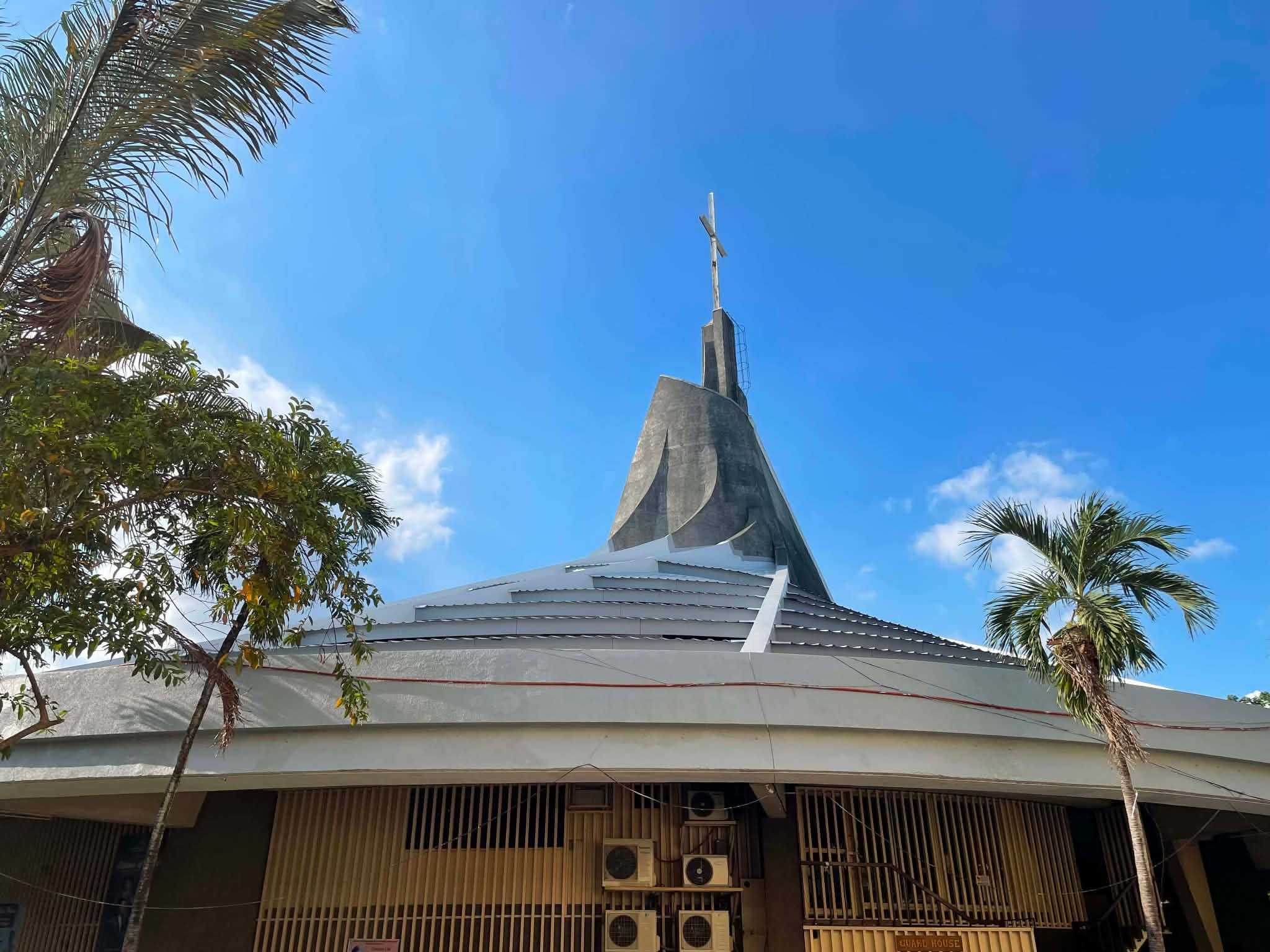
IHMP stands tall and proud with a structure that is very Filipino. From afar it seems as there is a giant salakot (a form of Filipino headgear) that sprouts amidst lush vegetation and houses in both UP Village and Teachers Village. This unique design for a Church was brough about by National Artist for Architecture Leandro Locsin. While Locsin is hailed for his Brutalist architecture (as seen in his other masterpieces such as the Cultural Center of the Philippines (CCP) and Philippine International Convention Center (PICC) characterized by massive, geometric, and monolithic forms made of raw, unfinished materials (such as concrete), IHMP seems to take a different route. It was in its time very modern. The church has no walls and is surrounded by metal geometric poles. A little off-center is a massive wall that has a huge cross with a risen Christ. This wall serves as the main support of the church which, from the outside looks like rays coming together to hold the Church's cross. These support beams extend to the roof and serve as buttresses. This gives the Church roof its salakot-like design. However, from an aerial perspective, the shape of the Church is that of a nautilus shell--endemic to the Philippines. With brutalist elements such as concrete and a seemingly unfinished facade mixed with curves and wood, the end-design is uniquely Filipino--for the ever-growing community of the Parish dedicated to the Immaculate Heart of Mary.
Another note-worthy feature of the Immaculate Heart of Mary Parish as to why it was elevated to an important cultural property by the NCCA are the massive Stations of the Cross spread around the Church. The massive sculptures were carved by the National Artist for Sculpture Napoleon Abueva. The 14 stations (referencing to the old versions of the Stations of the Cross) depict the passion of Jesus from his sentencing by Pontius Pilate until his burial following his cruxifiction. As one looks at each station, they reflect on the passion of Christ. But one can also notice that of the 14, 12 stations seem to be from a perspective of someone looking at the scene while 2 stations are depicted from an aerial point of view. This is because Abueva also wanted people to imagine how it looked like if God was watching his Son from heaven.
With the NCCA's citation in 2019, the Immaculate Heart of Mary Parish became one of the tourist destinations in Quezon City, as well as part of the Maginhawa Art and Food Hub.